
Select your location
Wer bist du ?
Wählen Sie einen anderen Ort
Who are you ?
Select another location
Who are you ?
Select another location
Qui êtes vous ?
Sélectionnez un autre emplacement
Who are you ?
Select another location
Qui êtes vous ?
Sélectionnez un autre emplacement
Who are you ?
Select another location
Who are you ?
Select another location
Who are you ?
Select another location
Qui êtes vous ?
Sélectionnez un autre emplacement
Wer bist du ?
Wählen Sie einen anderen Ort
Who are you ?
Select another location
Who are you ?
Select another location
Who are you ?
Select another location
Who are you ?
Select another location
Who are you ?
Select another location
tu chi sei ?
Seleziona un'altra posizione
Wer bist du ?
Wählen Sie einen anderen Ort
Who are you ?
Select another location
Qui êtes vous ?
Sélectionnez un autre emplacement
Who are you ?
Select another location
Who are you ?
Select another location
Who are you ?
Select another location
Who are you ?
Select another location
Who are you ?
Select another location
Quién eres tú ?
Seleccione otra ubicación
Who are you ?
Select another location
Wer bist du ?
Wählen Sie einen anderen Ort
Who are you ?
Select another location
Qui êtes vous ?
Sélectionnez un autre emplacement
Who are you ?
Select another location
Who are you ?
Select another location
Who are you ?
INSTITUTIONS
Select another location
Who are you ?
RETIREMENT PLAN INVESTOR
Use your plan ID (available on your account statement) to determine which employer-sponsored retirement plan website to use:
IF YOUR PLAN ID BEGINS WITH IRK, BRK, 754, 1 OR 2
Visit americanfunds.com/retire
IF YOUR PLAN ID BEGINS WITH 34 OR 135
-
ABOUT RETIREMENT PLANS
DEVELOP INVESTMENT STRATEGY
CHANGING NEEDS
LIFE STAGES
OTHER REFERENCES
-
-
-
FUND INFORMATION
Diversify your assets
You can reduce the risk in your portfolio by spreading your investment dollars among different types of assets. This is known as diversification.
How diversification works
Investments may lose and gain value at different times. When some investments are down, others may be up. If the values of certain investments have declined significantly, others may not have fallen as much.
If you put all of your money into a single investment, you’d be depending solely on the return of that one investment — for better or worse. Your overall returns would fluctuate right along with any ups and downs of the one investment.
An alternate strategy is to diversify your investments. By spreading your risk, your overall returns wouldn’t reach the lowest lows or the highest highs of any single investment you own. Diversifying your portfolio will help reduce its overall volatility.
Stocks vs. bonds example
Since 1926, stocks have provided a higher return than bonds in 55 of 88 calendar years* — far from an overwhelming advantage. Bonds had a higher return in the other 33 years, so you need to put money in stocks as well as bonds if you want the opportunity to benefit from both.
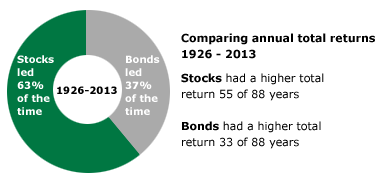
* Based on year-by-year total returns. Source: for stocks, Ibbotson Large Company Stocks Index; for bonds, Ibbotson Long-Term Corporate Index.
Invest for your time horizon
How many years before you retire? Use the answer to create an effective plan.
Asset allocation models
Use our sample portfolios as a guide to build your investment strategy.
Investments are not FDIC-insured, nor are they deposits of or guaranteed by a bank or any other entity, so they may lose value.
Investors should carefully consider investment objectives, risks, charges and expenses. This and other important information is contained in the fund prospectuses and summary prospectuses, which can be obtained from a financial professional and should be read carefully before investing.
All Capital Group trademarks mentioned are owned by The Capital Group Companies, Inc., an affiliated company or fund. All other company and product names mentioned are the property of their respective companies.
Use of this website is intended for U.S. residents only.
American Funds Distributors, Inc.
This content, developed by Capital Group, home of American Funds, should not be used as a primary basis for investment decisions and is not intended to serve as impartial investment or fiduciary advice.